How to Play Softball?
Softball is a variant of baseball played with a larger ball on a smaller field. It was invented in 1887 in Chicago, Illinois, United States as an indoor game. It was at various times called indoor baseball, mush ball, playground, softball, kitten ball, and because it was also played by women, ladies' baseball. The name softball was given to the game in 1926, because the ball used to be soft.
First Know the Rules
Most softball games consist of seven innings, each with two halves. The first (or "top") half is when the visiting team bats. The second (or "bottom") half is when the home team bats. Each half-inning is played until the fielding team manages to put out three batters or baserunners.- The pitcher will pitch to a batter until one of four things happens:
- The batter gets three strikes against him/her. A strike occurs when the batter swings at a pitch but misses it (or hits it foul with less than two strikes against him/her), or when the pitch passes through the strike zone but the batter does not swing at it.
- The pitcher throws four "balls," which are pitches that fail to pass through the strike zone and which are not swung at by the batter. In this case the batter "walks," meaning s/he is awarded first base.
- The pitcher hits the batter with a pitch. In this case, too, the batter is awarded first base. (This applies only to fast-pitch softball. There is no such thing as a hit batter in slow-pitch.)
- The batter reaches base safely by virtue of a hit, a fielder's choice, or a fielding error (or rarer occurrences such as catcher's or runner's interference).
- To get a batter out, a pitcher can record three strikes against the batter, or a fielder can catch a batted fly-ball (in either fair or foul territory) before it hits the ground.
- If the batter hits a ground ball, s/he will be out at first base if a fielder can secure the batted ball and throw it to the first baseman who steps on first base before the batter can do so.
- To get a runner out, an infielder can tag the runner with the ball (or the gloved ball) while the runner is between bases.
- In the case of a "force out," a runner is forced to advance to the next base when there is nowhere else for him/her to go, and s/he may be put out by any infielder who while holding the ball steps on the base before the runner arrives there. In this case the fielder does not have to tag the runner. A force out commonly occurs when a batter hits the ball to an infielder, who throws it (or runs it) to first base before the batter can run there.
- When a batter hits a fair ball s/he may attempt to run as far around the bases as s/he thinks possible without being tagged out by the defense. Every time a runner crosses home plate, they score one “run” (or point) for their team.
- At the end of seven innings, the team with more runs wins the game. If the score is tied, the choice can be made to let the game end in a tie or play one or more extra innings until one team is ahead at the end of an inning.
Second Know the Positions
When a team is fielding (playing defense), each player is assigned a specific position on the field. There are two general areas of the field, the infield and the outfield.- The infield is the dirt section of the field. The infielders consist of the pitcher, catcher, first baseman, second baseman, shortstop, and third baseman.
- The outfield is the grassy section farther from home plate consisting of left, center, and right field with an outfielder stationed in each. Some leagues (particularly in slow-pitch) allow a fourth outfielder such that the positions are left, left-center, right-center and right field.
- Although the catcher and pitcher are infielders, they are specialized positions that involve added practice time, often separate from the rest of the team.

Third Gather the Equipment
Ball: Softballs used for youth and high school levels are usually bright yellow, around 12 inches in circumference and weigh around 180-200 grams. They are not “soft,” as the name of the sport implies; rather, they are made of hard leather filled with cork, rubber and synthetic materials.Glove/Mitt: Softball gloves are often larger than those used in baseball because the ball is bigger. Most players choose to wear gloves, which differ from mitts in that they have individual fingers and less padding. First basemen and catchers usually wear mitts with extra padding to catch balls thrown at higher speeds.
Bat: Youth softball bats are generally the same as youth baseball bats. They are made out of wood, aluminum or composite materials. Adult softball bats, however, are generally longer with a smaller diameter, and the barrels are less stiff than their baseball counterparts. The NCAA, in an effort to limit the performance of aluminum and composite bats, limits the weight to length ratio of the bat. A bat must be as long (in inches) as it weighs (in ounces), and the weight cannot be any more than three ounces less than the number of inches it is long. In appearance, softball bats have thinner, more tapered handles than baseball bats. Due to differences in the construction of baseballs and softballs, a baseball bat can be used adequately to play softball, but a softball bat will likely break if used to strike a baseball.
Batting Helmet: The most important piece of safety equipment in softball is the batting helmet. Constructed of rigid durable plastic and foam, softball helmets help to distribute the forces of any ball that strikes the batter's head. Differences between baseball and softball helmets include optional wire face guards and pony tail channels for female athletes.
Sliding Shorts and Sliders: Sliding shorts are padded upper thigh synthetic compression leggings that protect the athlete when sliding into a base. Sliders resemble shin guards and protect the shin and calf from injury when sliding.
Catcher's Equipment: Softball catchers must wear helmets with face guards and throat protectors, body protection (chest protectors) and shin guards that reach up above the knees. Failure to wear full body protection while catching can result in serious injuries.
Read more: http://www.momsteam.com/sports/softball-fast-pitch/equipment/basic-softball-equipment-and-gear#ixzz5Akgy837I
Fourth Know How to pitch and bat
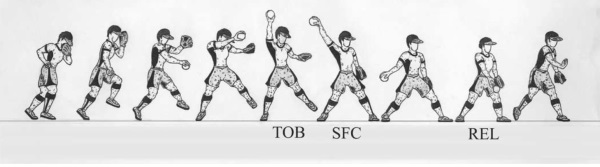
Steps in Pitching?
Step 1
Stand on the mound with both feet. Stand on your toes with your left foot and keep your right foot flat. Keep the softball in your throwing hand. Preferably grip the softball with a four-seam grip, but to begin with go with what is comfortable.
Step 2
Grip the ball. If you are naturally right handed, hold the ball in your right hand with your index, middle, ring, and little fingers on a straight seam, while your thumb grips the straight seam on the opposite side of the ball. Try to allow some space between your palm and the ball.
Step 3
Place your feet on the pitching mound with the ball of your right foot on the front edge (nearest home plate) and the ball of your left foot on the back edge. Your hips should be square to home plate.
Step 4
Shift your weight back onto your left foot while bringing your gloved left hand and your ball-hand together and up toward your face.
Step 5
In one smooth motion, extend your right arm down past your hip and bring your left arm in to your chest while placing your weight onto your right foot. This is the beginning momentum for your pitch.
Step 6
Kick your left foot forward and push off the rubber with your right foot.
Step 7
Pivot or "open" your hips so that your left side is facing home plate and your front is facing third base. Simultaneously with your foot movements, keep your arms straight and bring both of your arms up in front of you. The left gloved hand stops at about eye level and the ball hand continues its circle up until it is extended toward the sky.
Step 8
Cock your right wrist back.
Step 9
Bring both arms down quickly at the same time. Your right arm should cross in front of your "open" hips.
Step 10
Snap your wrist forward, releasing the ball at the same time that the glove hand reaches your side.
Step 11
After the snap, drag your right foot forward to your left(don't lift your foot off of the ground or it could be considered an illegal pitch), "closing" your hips. Your body should be square toward the plate again. Do not close your hips before you release the ball.
Step 12
Follow through with your right arm bringing it forward and bending it at the elbow so that your elbow points toward home plate.
Step 13
End your pitch so that your knees are bent and your glove is ready to field the ball in the event it is hit.
Steps on how to bat
Step 1
Ready your stance. When you’re up to bat it is not enough just to stand at the plate. Here are a few batting-stance tips to keep in mind every time you go up to hit:
Keep your feet at shoulder width from each other. Place them equi-distant from home plate (unless you're trying to hit down one foul line or the other).
Bend your knees and lean slightly toward home plate.
Put more weight on your back leg. When you swing you will push off using your back leg for power.
Keep the appropriate distance from the plate. To know how far away you should stand, stick your bat straight out over home plate as if you were in mid-swing. The barrel of the bat should be above the center of the plate. If not, back up or move closer to the plate.
Step 2
Hold the bat in a comfortable grip. When you bat you should be holding the rubber grip near the knobbed end. Your throwing hand should be higher on the bat than your non-throwing hand, and your hands should be touching each other as they grip the bat.
Line up your knuckles on the handle of the bat.
When you take your stance the bat should be held at a slight angle from vertical above your back shoulder.
Hold the bat with your hands near your ear.
Step 3
Prepare to swing. Maintain your batting stance as the pitch comes toward you. Keep your knees bent and the bat positioned near your ear.
Step 4
Swing to hit the ball. Keep the bat horizontal as it sweeps through the strike zone. Don't reach for a bad pitch. Patiently wait for a good pitch. Swinging at a bad pitch rarely results in a hit.
Swing “shoulder to shoulder.” This means that your chin starts out near your non-throwing shoulder, and you swing all the way around so that your throwing shoulder finishes near your chin.
Swing hard with a strong follow-through. This means to continue the swing until the bat almost touches your non-throwing shoulder. If you hit the ball, don’t drop the bat as soon as you make contact, as you will lose half of your power. Use all your strength and continue the swing until the bat has moved to the other side of your body.
Move your feet. Most batters take a small step with their front foot toward the pitcher as they swing. The back foot normally remains planted, although you may find that you pivot on the ball of your back foot as you swing.
An exception to the rule of keeping your back foot planted on the ground occurs if you're trying to hit to the opposite field. For instance, if a right-handed batter is trying to hit to right field, s/he may want to move her/his right foot farther from the plate just before swinging, thus facing more toward right field.
Rotate your body with the swing. Remain flexible while you swing by twisting your torso slightly. This will add power to your swing.
Keep your eye on the ball. Watch it all the way from the pitcher's hand to the point of contact with the bat. This will improve your chances of hitting the ball solidly.
Once you hit the ball, softball etiquette requires that you not throw the bat. Instead, drop it as carefully as possible outside the baseline so that nobody trips over it.
Step 5
Move toward first base once you've hit a fair ball. Your goal is to get on base safely.
If you're not sure whether your batted ball will land in fair territory, run hard toward first base until an umpire has indicated the ball is foul. Your first-base coach will help you decide whether to stop at first base or keep running. Your job is making it safely to or beyond first base rather than watching what is happening in the outfield. That's the coach's job.
Fifth Fielding
The fielding side must try to get the batsman out and it can be done in three ways which are −- Force out
- Tagged out
- Fly out
If a fielder, while holding the ball, touches a base which is the only base towards which the batter may run and she does it before the batter arrives there is called force out.
If a fielder touches a base while holding the ball before the batsman reaches it, it is called force out.
The time a batsman goes to a base that is already tagged is called as tagged out. When the ball hit by the batter is caught by a fielder it is called fly out. Like catch out in cricket, fly out is the common in softball.
Resources:
https://www.wikihow.com/Play-Softball
https://www.tutorialspoint.com/softball/index.htm
https://stormininnorman.com
https://encrypted-tbn0.gstatic.com/images?q=tbn:ANd9GcSE5q7AfrTi6VF2NBeJyoloV-eIyKQFFp62-UnZQXff5WYZbzto
https://www.wikipedia.com
Comments
Post a Comment